Regulatory Intelligence forBetter MedTech Decisions
Agent Astro helps teams connect evidence, context, and institutional knowledge across regulatory strategy, product development, quality, clinical, and commercialization activities.
Predicate and Precedent Intelligence
Identify relevant predicates, precedents, and regulatory pathways. Understand how comparable devices were positioned, reviewed, tested, and cleared.
Device and Strategy Comparison
Compare devices,indications,technologies, testing approaches, standards, and regulatory strategies side by side.
Structured Regulatory Outputs
Generate traceable reports, comparison tables, predicate analyses, and supporting narratives that help teams act with greater clarity.
Market and Lifecycle Intelligence
Explore regulatory trends, competitive activity, product evolution, recalls, adverse events, and changing expectations across the product lifecycle.
Predicate and Precedent Intelligence
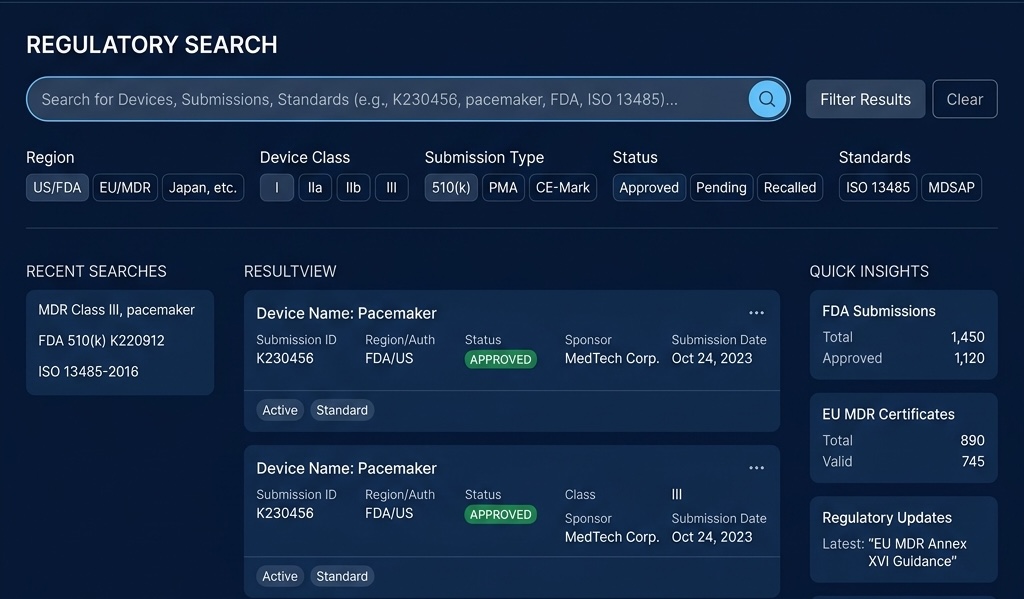
Agent Astro helps teams identify and evaluate relevant predicates, precedents, and related devices using natural language. Move beyond keyword searches and understand how comparable products, technologies, indications, and testing approaches have been positioned over time.
Structured Regulatory Outputs
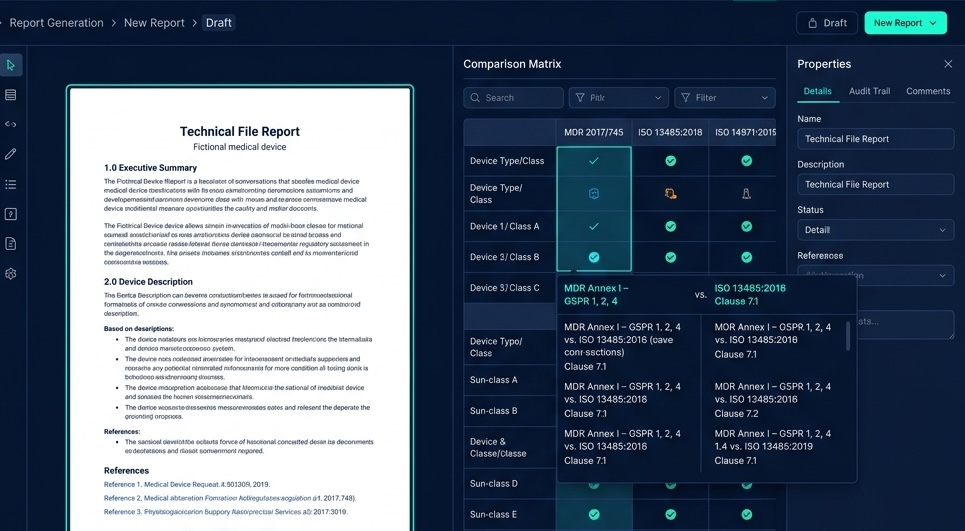
Generate structured, traceable outputs that support internal planning, regulatory strategy, submission preparation, product development, quality, and commercialization decisions.
Secure Regulatory Knowledge Workspace
Work with sensitive regulatory and product information in a secure environment designed to protect proprietary knowledge, internal documents, and strategic decision-making.
Strategic Device Comparison
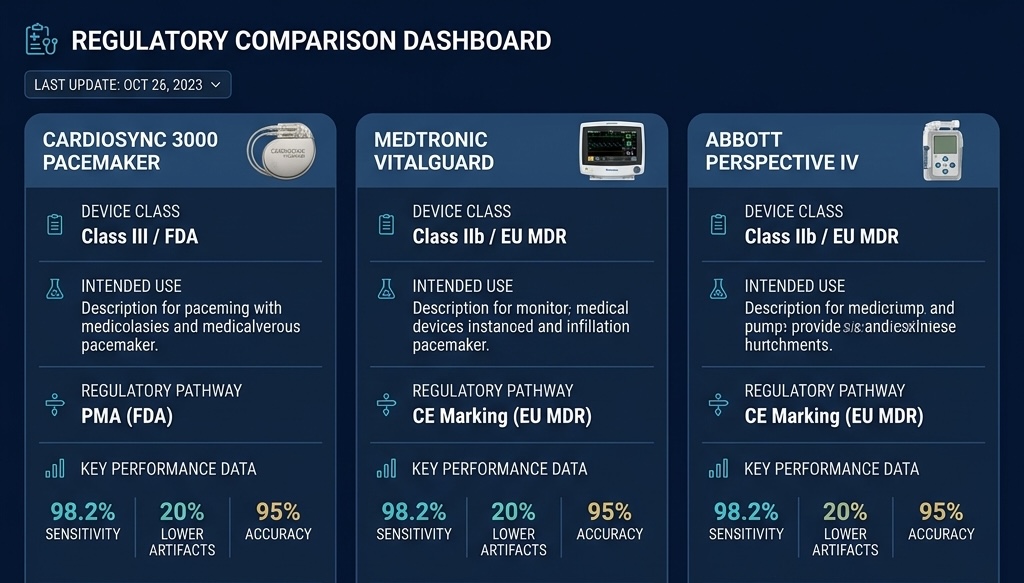
Compare devices across intended use, technological characteristics, materials, testing, standards, predicates, pathways, and potential regulatory implications.
Inside the platform
How the work actually gets done
Astro Intelligence
An agent that asks before it spends your time
Ask in plain language. The copilot works the quick lookups itself - device records, similar clearances, recalls, applicable guidance - and when a question deserves a heavier engine, it proposes the run with an editable scope and a time estimate. You confirm; the finished report docks beside the chat.
Deep Search
Find the precedent you would not have thought to search for
Three retrievals run at once - exact keyword, semantic similarity, and indications-for-use phrasing - and fuse into one ranking. Comparable devices surface even when they share none of your vocabulary.
Predicate Investigation
Walk the lineage, not a list of search results
Every clearance claims equivalence to an earlier device, so the record is a graph. Agent Astro traverses it, so you can trace a predicate's ancestry, pressure-test it, and build the substantial-equivalence argument on what the record supports.
Scenario Compare
Ten dimensions, assembled from the filings
Compare devices across the dimensions a reviewer actually weighs - description, indications, technological characteristics, performance testing, consensus standards, post-market profile - drawn from the submissions themselves.
Regulatory Pathway
See why a pathway was recommended, not just which
Candidate pathways are scored against your device profile and the evidence behind it. You get the recommendation, the alternatives it beat, the open questions, and the citations to check the reasoning yourself.
eSTAR Builder
Catch the gap while it is still cheap to fix
Draft eSTAR sections, run a pre-flight against refuse-to-accept criteria, and see what is missing before submission rather than after. Export an import-ready workbook when it is clean.
Substantial Equivalence
A draft that shows its sources
Generate the substantial-equivalence narrative in the structure a 510(k) expects, grounded in the retrieved filings and pinned to verbatim numbers, dates, and standards, so every claim can be traced back.
Deep Research
Research that checks its own gaps before it writes
A research question becomes a plan of sub-questions, rounds of evidence gathering, a gap check, and citation verification - then a memo with exhibits. Every finding carries its sources, and you can interrogate the finished report in place.
Project Materials
Drop your files; the evidence room sorts itself
Uploads are read, classified into regulatory categories - IFU, bench testing, biocompatibility, sterilization, software, prior submissions - and mined for key facts. When two documents disagree, the contradiction is flagged, not averaged away.
Regulatory Monitor
The record changes daily. Watch the part that is yours.
Watch devices, product codes, applicants, and guidance topics. The platform checks the FDA's clearance, recall, and adverse-event feeds every day and surfaces only what changed - quiet days stay quiet.
Model Context Protocol
Use Agent Astro from the assistant you already work in.
MCP is the standard that lets an AI assistant call outside tools. Connect Agent Astro once and Claude, ChatGPT or your editor can reach the corpus, run the assessments and open work in your workspace, without you leaving the conversation.
A search tool cannot tell you no.
Most regulatory connectors are a set of search endpoints. They hand the model a list and leave it to decide what the list means, so the answer is only ever as good as whatever that model happens to know about your device class on the day you ask.
These tools return a judgement instead: a verdict, the criteria behind it, and the evidence for each one. When the right answer is that your device has no predicate to find, that is the answer you get - along with the reason.
Being told you are asking the wrong question is worth more than a fast answer to it.
Eleven tools, in three tiers.
Tools that reach a verdict
Each returns a decision, the criteria behind it and a confidence - and can answer that the evidence is insufficient instead of guessing.
assess_predicate_suitabilityReturns SUITABLE, SUITABLE_WITH_RISK, UNSUITABLE or INSUFFICIENT_EVIDENCE, with a pass or fail against each statutory criterion.
find_candidate_predicatesRanked candidates, each with the reason it ranked - and an excluded list naming what was rejected and why.
trace_predicate_lineageWalks the clearance graph: ancestors, depth, breaks in the chain, and any recalled device in the line.
score_device_twinThree peer-relative axes - lineage, safety, pedigree - each with a percentile, its components and a stated confidence.
Tools that ground an answer
Retrieval exists to serve the verdicts. None of these returns a raw dump for the model to sort out.
resolve_deviceTurns an identifier or a product name into one canonical device. Ambiguous input returns candidates rather than a guess.
verify_identifiersChecks a list of K, P or DEN numbers against the corpus, so a model can find out which ones it invented.
search_guidanceDevice-aware search across the synced FDA guidance layer.
searchCorpus search shaped for ChatGPT deep research, with a source URL per record.
fetchRetrieves one full device record by id, the companion to search.
Tools that change something
Annotated as writes, so your assistant asks before it runs one. Both need a signed-in account to attach the work to.
create_regulatory_projectAsks firstOpens a project in your workspace, identical to one created in the app - same company, same activity feed, shared with your team.
add_to_watchlistAsks firstPuts a device, product code or applicant under Regulatory Monitor, and it reaches you in the daily digest.
Connect it in about a minute.
There is no key to generate. Paste the server URL into your assistant, sign in with your Agent Astro account, and approve the connection once.
Server URL
https://mcp.agentastro.ai/mcp
What it can and cannot do.
Your own account
Connecting signs you in through the same login the app uses. There is no API key to mint, paste or rotate.
The same subscription gate
A connector inherits every check the web app applies. It cannot reach anything your account cannot.
Writes ask first
The two tools that change something are annotated as writes, so your assistant prompts you before running one.
No reach into your chat
Nothing here reads your conversation history, your memory or your files. The tools take arguments and nothing else.